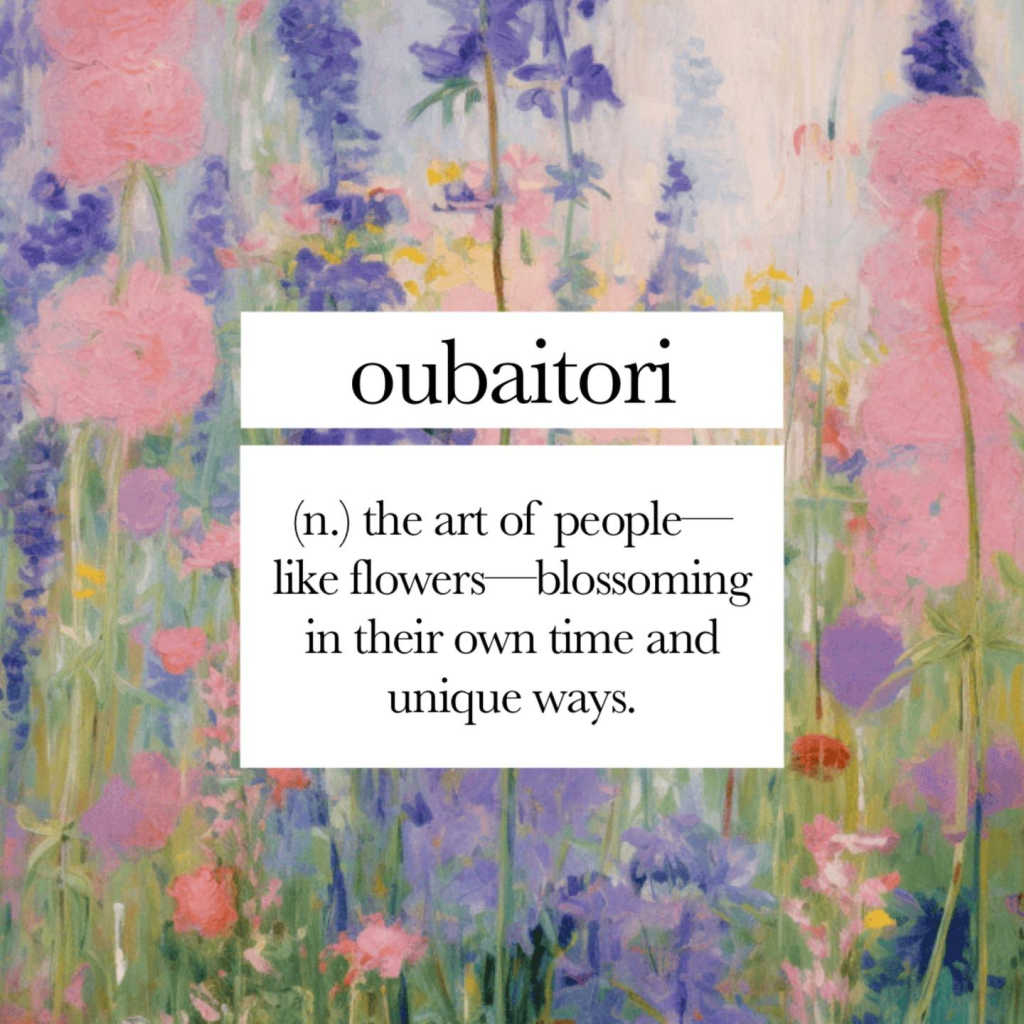
Oubatori
The Beauty of Your Own Bloom
By Samantha Shrock
Nature cycles through vivid and hidden rhythms of growth.
One elegant example is found in the concept of oubaitori. This Japanese word refers to the four distinct fruit trees that blossom during the country’s spring season: “cherry, plum, peach, and apricot.”
These trees share a season of renewal, yet bloom in intervals. Plum flowers appear first, followed by apricot, then peach, and finally cherry. These staggered windows of formation highlight intricacy and originality, enhancing the detailed beauty of each unique tree.
How true is this of people?
Being an “early” or “late” bloomer doesn’t expand or confine you. Your speed of growth doesn’t define your capacity to create a beautiful life. One method is not superior to another—we each bloom in our own time. Oubaitori cautions against comparison, advising instead to celebrate the beauty of each unique formation. Growth is not a race; it is a rhythm.
Seasonal awareness is mindfully embedded in Japanese culture. The recognition of fleeting beauty—sometimes referred to as mono no aware, the gentle awareness of impermanence—encouraging attentiveness to timing, change, and transience. Oubaitori reflects this same sensibility. It suggests that difference in timing is not deficiency—it is design.
This stands in sharp contrast to the optics and metrics that shape modern life.
From early education to adulthood, we are trained in the art of comparison. Who learned first, who advanced faster, who achieved more, who arrived sooner. In professional spaces, comparison can become even more pronounced—promotions, prestige, output, influence. In personal life, milestones are measured against peer-averaged pacing.
Yet human development—psychologically, emotionally, professionally—is beautifully nonlinear.
Developmental psychology reveals that growth occurs in uneven stages. Experiential skills of tenacity, resilience, and emotional maturity emerge at rates relative to environment, temperament, and opportunity. Outward “delay” may disguise depth in process, while rapid ascension without groundwork eventually exposes an unstable foundation.
Comparison distorts the beauty of becoming. Neurologically, comparison activates threat responses in the brain. This triggers stress and insecurity, minimizing perspective. We unintentionally shift from growth to self-scrutiny—Am I ahead or behind?
Oubaitori invites a different frame:
Am I developing?
Still, there is a distinction between stewardship and stagnation. Growth is cultivated through diligence and consistency. A tree doesn’t bloom without steady nourishment—but a tree doesn’t bloom faster because its neighbor is further along. In oubaitori, these fruit trees don’t compete; they simply fulfill their nature.
Mastery takes time. Some rise quickly into leadership roles and learn in the fire; others accumulate quiet experience before stepping forward. Both trajectories produce capable, thoughtful leaders. Speed is not the sole indicator of readiness.
Your timing is your own. Your growth is your own.
This truth invites patience, self-compassion, and reflection. It encourages us to recognize that our unique trajectory will yield fruit in its own season. When it does, it will be beautiful, just as each tree in the orchard blooms in its appointed time.
Consider your own “season of bloom.” Are you rushing your growth, comparing yourself to others, or overlooking the steady development you’ve already made?
The cherry tree does not outshine the plum. It blooms at the right time—and so will you.
 Samantha Shrock