- Fear to Faith: Rewiring the Anxious Mind
- Everyone Else Is Doing It
- Empowering the Voiceless: CASA Interview
- Child of God
- Oubatori
- Bible Study Curriculum: Who is God?
Fear to Faith: Rewiring the Anxious Mind
A Neurobiological and Biblical Essay
By Samantha Shrock
Rushing to accomplish things in our own strength is our own detriment.
When we fixate on strategizing outcomes that align with the narratives in our minds, it’s not just theoretically depleting—it’s physiologically destructive. The stress of striving wreaks havoc on our systems on a cellular level.
Micromanagement is a buzzy concept. Its traction conflates it, priming the “Type A” personality for misinterpretation. Clashing narratives compete for our attention. One day, the internet praises micromanagement for proactive assertion; the next, it’s condemned for manipulative control. Impressionable minds orient toward opinion instead of anchoring in fact, so ideals shift with the tides of digital trends.
Beneath layers of social commentary, substantial data on axis patterns in the brain suggest that neuroticism fuels a chronic dysregulation of the nervous system.¹ In other words, the stress of maintaining control erodes trust between our brains and bodies. From a spiritual perspective, idolizing control defeats the purpose (and freedom) of faith. Neurological health actually deteriorates when we live in a chronic state of fear. When fear-based motivation governs our thoughts, feelings, and behavior, we are operating in a deficit of faith. At its core, the remarkable beauty of sustained faith in a power that exceeds ourselves is that it stabilizes our brains and bodies into harmony with one another.²
Some genetics have a propensity toward anxiety. Stress thresholds are highly heritable.³ But heritability doesn’t define people as products of their genetics or environment. Christ seeks to rewire the anxiety-ridden pathways forged in our brains. If our brains are constantly reacting and adapting to new stimuli, who says those pathways can’t be reconstructed?
In 1890, psychologist William James coined the term “plasticity”, describing the brain as a structure that is weak enough to conform to change, yet strong enough to withstand change.⁴ A chain of scientists through the 20th century explored and developed James’ theory, involving the discovery of neural synapses: lines of communication between cells in the brain that release chemical signals to forge pathways.5 This neural development is not exclusive to childhood; synapses reduce over time, yet persist through adulthood. Our brains never stop ‘becoming’—they are always in motion.
Dr. Caroline Leaf, a Bible-believing neuroscientist, pioneered a scriptural approach to this theory. Leaf proposes that—if neuroplasticity affirms the nervous system’s structural response to thought and emotion—God designed the malleability of our minds to power the health of our brains.⁶
The brain is the epicenter and powerhouse of the nervous system. If our brains bend to the whims of our thoughts and feelings, patterns of stress can be repeatedly reinforced, which overstimulates with excessive fight-or-flight. This dysregulation activates a sustained release of cortisol and inclines us toward a sympathetic (SNS) baseline. The neurological and adrenal response to stress is a quietly addictive shift in our brains.7 If we achieve something great in a dysregulated state, it gives us a rush of feel-good hormones: dopamine, endorphins, and oxytocin. Our brains track that dysregulation as a marker of success, reactivating that sympathetic state to achieve the same results. Time and again.
A sympathetic nervous state instinctively sounds an alarm that signals high stakes. When this state yields positive results, our brains reward success–no matter the means. We become hooked on a gratification system that equates the panic of cortisol with the relief of dopamine. Even so, our brains fail to log the long-term consequences of this sequence in real time. Optimizing intensity compromises longevity. Prolonged cycles of intense stress and relief are linked to reduced memory, impaired decision-making, and heightened emotional reactivity.⁸ After defaulting to fight-or-flight, the process of regulation can feel anticlimactic without the addictive rush. Even so, a regulated nervous system stabilizes into a more peaceful, sustainable rhythm of life.
Striving to do things our own way keeps us suspended in instability. When we rely on fickle earthly rhythms to secure our state of mind, we mistake certainty for peace. The Bible affirms that the only unwavering source of certainty is Jesus Christ. Apart from him, nothing is guaranteed.
Scripture is heavily saturated with references to this holistic transformation–spiritual, mental, and physical. A born-again believer who commits their life to Christ is invited to begin walking a journey of sanctification. 2 Corinthians 5:17 describes this rebirth: “Therefore, if anyone is in Christ, he is a new creation. The old has passed away; behold, the new has come.” Christ’s atonement covers our sins, but we are called to shed our earthly layers that bind us in the flesh as we embrace a new identity in Christ. Romans 12:2 articulates this transformation as a literal renewing of the mind. How uncanny is the resemblance between science (neuroplasticity) and scripture (mental renewal) here?
We are clay to be molded in the Potter’s hands. Isaiah 64:8 and Jeremiah 18:6 both highlight this vivid metaphor. We are made in the image of God–each bearing unique qualities as gifts that resemble God’s character. Even so, we are born with a nature that defies our Creator. Our flesh separates us from God, which is why embracing every facet of ‘how we were born’ or ‘how we are’ is not innocent self-acceptance… it’s simply unbiblical. When we invite Christ to cleanse and redeem us, we are also inviting him to do a deep, transformative, and often uncomfortable work in us. He welcomes us with open arms and calls us to come as we are, but committing our lives to him doesn’t mean staying where we are. The molding and shaping can be painful, as refining is often purging. We are inviting him to remove impurities of the flesh so the fruits of the Spirit can produce abundant life. Jesus conveys this sacrifice in multiple passages, including Matthew 10:39: “If you cling to your life, you will lose it; but if you give up your life for me, you will find it.” John 10:10 is another beautiful articulation of Jesus’ promise: “The thief comes only to steal, kill, and destroy. I came that they may have life and have it abundantly.”
God didn’t wire our bodies and minds to rush, strategize, and calculate our way to success. He also did not create us for passivity or stagnancy. Instead, He mentors us into active faith, inviting us into the peace and stability of releasing control in a posture of trust–especially when that trust doesn’t come naturally. The transformation isn’t promised to be seamless, as denying our flesh defies our nature. Yet, Christ empowers us to reclaim regulation and live as we were truly designed: motivated by faith instead of fear.
- Van Santen A, Vreeburg SA, Van der Does AJW, et al. Personality characteristics and hypothalamic–pituitary–adrenal axis regulation in older adults: neuroticism as a vulnerability factor for HPA axis dysregulation. Stress. 2011;14(4):384-394. doi:10.3109/10253890.2010.545461.
- Ferguson MA, Schaper FLWVJ, Cohen A, et al. A neural circuit for spirituality and religiosity derived from patients with brain lesions. Biol Psychiatry. 2022;91(4):380-388. doi:10.1016/j.biopsych.2021.06.016.
- Strom NI, Verhulst B, Bacanu SA, et al. Genome‑wide association study of major anxiety disorders in 122,341 European‑ancestry cases identifies 58 loci and highlights GABAergic signaling. Nat Genet. 2026;58:275‑288. doi:10.1038/s41588‑025‑02485‑8
- James W. The Principles of Psychology. Vol 1. Henry Holt and Company; 1890.
- Berlucchi G, Buchtel HA. Neuronal plasticity: historical roots and evolution of meaning. Exp Brain Res. 2008;192(3):307-319. doi:10.1007/s00221-008-1611-6.
- Leaf C. Switch on Your Brain. Tafelberg; 2005.
- Koob GF. Addiction is a reward deficit and stress surfeit disorder. Front Psychiatry. 2013;4:72. doi:10.3389/fpsyt.2013.00072
- McEwen BS, Nasca C, Gray JD. Stress effects on neuronal structure: hippocampus, amygdala, and prefrontal cortex. Neuropsychopharmacology. 2016;41(1):3–23. doi:10.1038/npp.2015.171
*All scriptural references are from the English Standard Version (ESV).
Everyone Else Is Doing It
The Teen Habit Crisis – Why ‘Normal’ Isn’t Safe
By Samantha Shrock
We associate teenage risk with the obvious culprits: weed, booze, porn.
Getting high? Getting drunk? Hooking up?
Everyone else is doing it.
We monitor the extremes. The vices that community condemns.
But desensitization doesn’t stop there.
Doom scrolling for hours. Energy drinks for breakfast. AI for advice.
Somewhere along the way, we mistook “common” for “safe.”
Because everyone else is doing it.
Teen mental illness has skyrocketed over the past decade. Persistent hopelessness and suicidality in U.S. high school students have surged at alarming rates. The prevalence of depression climbed from 28% in 2011 to 42% in 2021,¹ and the pandemic introduced a staggering 50% increase in suicide attempts among adolescent girls.²
Currently, teens are averaging eight hours of daily screen time outside of schoolwork.³ 60% report chronic sleep deprivation.⁴ Meanwhile, caloric intake is deteriorating in quality. The diet of an average American teen is ultra-processed.⁵
These are not fringe behaviors—they are mainstream. Normalized. Collectively, they form a model of upbringing that is historically unprecedented.
This is not a crisis of weak teenagers. This is a pattern of culturally integrated habit that is reshaping life trajectory in real time.
In many ways, social media has replaced a social life. As of 2022, 95% of U.S. teens report using a social media platform, and nearly half say they are online “almost constantly.”⁶ The concern is not only time, but condition: sleep deprivation, constant comparison, cyberbullying, and an algorithm that amplifies the echo chamber of a curated feed. Ongoing analyses have linked excessive social media use to depression—especially among teen girls.⁷ Association alone does not pinpoint a culprit, but the escalation is undeniable: adolescence now lives in a vacuum where social optics are quantifiable, continuous, and public. We did not vote on this technological experiment. We simply inhabited it.
Because everyone else is using it.
Screen time plays a critical role in the mental health space, but nutrition is rarely credited for its contribution.
Roughly 67% of the calories consumed by U.S. youth are ultra-processed.⁹ These foods are engineered for palatability and convenience—high in refined carbohydrates, industrial seed oils, additives, sodium—and low in fiber and micronutrient density. While no single ingredient or statistic quantifies mental illness, ongoing research points to a consistent relationship between ultra-processed food and depression in adolescents.¹⁰ ¹¹
The science is sound. Diet drives blood sugar stability, inflammation levels, and gut microbiome—all of which vitalize the neural pathways responsible for mood regulation.¹² ¹³ Meanwhile, schools prioritize shelf life over nutrition to preserve cost effectiveness and infrastructure. When dual-income families face time constraints and low-income families face budget constraints, convenience and affordability become priorities.
Not fringe behavior. Not reckless neglect. Just normalized patterns.
Because everyone else is eating it.
If the teenage world has hopped into a screen, parenting has followed.
In 2014, researchers coined the term “technoference”—the reality of devices compromising lines of communication between parents and children.¹⁴ 85% of U.S. adults rely on a smartphone.¹⁵ Surveys indicate that many parents report feeling preoccupied with their devices during family time.¹⁶
Attachment research affirms that relational presence with consistency and attunement combats the effects of stress.¹⁷ Though teens require minimal physical caregiving compared to toddlers, they require the same level of relational stability to thrive. Yet, despite the necessity of intentional presence, the modern home normalizes parallel scrolling: teens in their rooms, parents on their phones. Passive cohabitation.
This is not a story of negligent parents, but of cultural drift. Work migrated to the living room. Connection hopped into the screen. Notifications dissolved boundaries between presence and absence.
Because everyone else is on their phone.
Social media can be corrosive, but it can also cultivate connection.
Processed foods provide affordability and access.
Technology permits flexible, connective work.
In isolation, these variables are negotiable.
For teens, they are bleeding together.
Thirty years ago, the internet did not exist. Today, teenage brains are developing in a digital pressure cooker. A comparison engine that never powers off. They sleep fewer hours than prior generations,⁴ consume copious amounts of ultra-processed food,⁹ and share attention with whatever digital content engrosses their parents around the clock.¹⁴
Simultaneously, prolonged sadness and hopelessness have soared,¹ school absenteeism has surged,¹⁸ and pediatric mental health services are waitlisted across the nation.¹⁹
Correlation is not causation. But convergence is the key.
As developmental structure shifts, cumulative impact becomes harder to ignore.
Blame is easy, but culture is not easily reprogrammed. Habit reversal feels unattainable—but habits are not fate.
If groupthink has become our baseline, we need a new consensus. A stronger conviction. Not perfection, but realistic margin.
Margin for sleep, boredom, nutrition, and real-life presence.
We struggle to tolerate this healthy friction. It feels unnatural because it clashes with our culture. We qualify time with productivity and efficiency. Regulating that intensity feels counterintuitive. Inconvenient. Even if our systems crave regulation, pausing registers as regression. When we postpone a response or task, we feel like we are falling behind.
Habits are not sustained through intensity, but through consistency. We do not need drastic revamps or moral spirals—just small actions to incorporate presence into routine.
Move the charger out of the bedroom.
Protect one device-free hour in the evening.
Reclaim one shared meal without parallel scrolling.
Turn off the cruise control of digital consumption when possible.
We retain the choice to reject habits that actively threaten the health and future of our youth.
Teens deserve better than regressing standards.
This is the experiment we never meant to conduct. But it is an experiment that we can reclaim. What has been desensitized can be resensitized. Resisting the flow will be clumsy and imperfect because it defies instinct—but persistence will pay off. Inconvenience now could transform into discipline and success later. Teenagers become adults who carry patterns and practices into their own lives.
What habits are you tolerating? What habits are you modeling?
Everyone else may be doing it…
But the cycle of complacency can end with you.
- Centers for Disease Control and Prevention. Youth Risk Behavior Survey Data Summary & Trends Report: 2011–2021. CDC; 2023.
- Yard E, Radhakrishnan L, Ballesteros MF, et al. Emergency department visits for suspected suicide attempts among persons aged 12–25 years before and during the COVID-19 pandemic—United States, January 2019–May 2021. MMWR Morb Mortal Wkly Rep. 2021;70(24):888–894.
- Rideout V, Robb MB. The Common Sense Census: Media Use by Tweens and Teens, 2021. Common Sense Media; 2021.
- Wheaton AG, Jones SE, Cooper AC, Croft JB. Short sleep duration among middle school and high school students—United States, 2015. MMWR Morb Mortal Wkly Rep. 2018;67(3):85–90.
- Wang L, Martínez Steele E, Du M, et al. Trends in consumption of ultra-processed foods among US youths aged 2–19 years, 1999–2018. JAMA. 2021;326(6):519–530.
- Pew Research Center. Teens, Social Media and Technology 2022. Pew; 2022.
- Twenge JM, Joiner TE, Rogers ML, Martin GN. Increases in depressive symptoms, suicide-related outcomes, and suicide rates among U.S. adolescents after 2010 and links to increased new media screen time. Clin Psychol Sci. 2018;6(1):3–17.
- Kelly Y, Zilanawala A, Booker C, Sacker A. Social media use and adolescent mental health: Findings from the UK Millennium Cohort Study. EClinicalMedicine. 2019;6:59–68.
- Wang L, Martínez Steele E, Du M, et al. Trends in consumption of ultra-processed foods among US youths aged 2–19 years, 1999–2018. JAMA. 2021;326(6):519–530.
- Rauber F, Chang K, Vamos EP, et al. Ultra-processed food consumption and risk of depression: A systematic review and meta-analysis. Nutr Neurosci. 2022.
- Adjibade M, Assmann KE, Andreeva VA, et al. Prospective association between ultra-processed food consumption and incident depressive symptoms. BMC Med. 2019;17:78.
- Marx W, Moseley G, Berk M, Jacka F. Nutritional psychiatry: The present state of the evidence. Proc Nutr Soc. 2017;76(4):427–436.
- Cryan JF, O’Riordan KJ, Sandhu K, et al. The gut microbiome in neurological disorders. Lancet Neurol. 2020;19(2):179–194.
- McDaniel BT, Radesky JS. Technoference: Parent distraction with technology and associations with child behavior problems. Child Dev. 2018;89(1):100–109.
- Pew Research Center. Mobile Fact Sheet. Pew; 2023.
- Radesky JS, Kistin C, Eisenberg S, et al. Parent perspectives on their mobile technology use: The excitement and exhaustion of constant connectivity. J Dev Behav Pediatr. 2016;37(9):694–701.
- Siegel DJ, Bryson TP. The Power of Showing Up. Random House; 2020.
- U.S. Department of Education. Chronic Absenteeism in the Nation’s Schools. 2022.
- American Academy of Pediatrics. Pediatric mental health emergency declaration. 2021.
Empowering the Voiceless: CASA Interview
Community feature exploring child advocacy and volunteer impact
Interview by Samantha Shrock
Many dream of making an impact, yet overlook their own communities. Local need is great, but hands are scarce. For Larry Nafziger, a retired educator and administrator of 42 years, service could have faded with retirement. Instead, it expanded.
Nafziger’s passion to invest in the future of local youth has endured beyond his career in education. Among his many volunteer roles, Nafziger has served more than 15 years as a Court-Appointed Special Advocate with National CASA/GAL Association. CASA is a nationwide nonprofit that trains volunteers to advocate for abused and neglected children in court. CASA’s core mission is to provide safe, stable, and permanent homes for every child in need. Over 79,000 volunteers annually serve more than 200,000 children across 890 active programs in the United States.1
Nafziger has encountered 10 cases in his 15 years with CASA. His longest assigned case spanned nearly five years. During his time as principal of Wakarusa Elementary School, Nafziger frequently crossed paths with CASA when the organization’s volunteers supported his students. That impact prompted Nafziger to be sworn in as a volunteer after retirement.
Q: Thank you for joining me, Larry. I know you’ve made such a positive impact on many children through this program. Could you describe some of your responsibilities as a CASA?
A: Thank you for having me. To become a CASA, I was sworn in by a juvenile magistrate and appointed my first case shortly after. I work with neglected and abused children who are struggling to thrive in broken homes. Volunteers meet with their assigned children a least once per month, though more frequent visits are encouraged. Volunteers also complete welfare checks to ensure the children’s parents are following through on medical appointments, vaccinations, and any other court mandates. Adequate food, clothing, and safe shelter are the key provisions in these checks. Volunteers are welcome to take on multiple cases, though two or three at a time is typically most manageable.
Q: How has your volunteer experience been most meaningful and rewarding for you?
A: I enjoy interacting with the children. I am currently assigned two sisters, a toddler and a one-year-old. Both were removed from their home due to parental abuse, including challenges the mother faced in addressing the younger child’s medical needs. I value the opportunity to advocate for these sisters, spend time with them, and support their wellbeing. I want them to feel that someone is looking out for them and wants them to thrive.
Q: What has been one of the most challenging variables of volunteering? I’m sure the cases pull at your heart strings.
A: It is heartbreaking to witness the situations these children face—they cannot protect themselves. Of my cases, neglect has been the most common form of abuse. I encounter many children who suffer from malnutrition and inadequate hygiene due to parental neglect. In some cases, these children are living in environments with pets that receive more attention and care than the children themselves.
Q: What seem to be the most common reasons children enter the protective service and foster systems?
A: In my experience, many of the parents who create unsafe living environments struggle with substance abuse, including alcohol, drugs, or prescription misuse. If a child is removed and the parent takes all necessary steps to get and stay clean during the separation, reunification becomes much more likely. There are powerful success stories when parents turn their lives around for their children, but in some cases, permanent separation is the best possible scenario to keep the children safe. Many of these adoption stories are also powerful celebrations, especially when children find security and a sense of belonging for the first time in their lives. Provisional and emotional support from a caretaker position a child to succeed.
Q: Have more of your cases closed with adoption or reunification? And do you stay in contact with the families after your cases close?
A: Cases tend to balance out evenly, with as many children returning home as being adopted into loving families. After a case closes, I cannot initiate contact–the parent or guardian must reach out first. Most cases are active anywhere from one to five years, so you spend quite a bit of time investing in a child’s life as a volunteer. Naturally, you attach and become protective of the child. Parting ways at the end of the case is difficult, but the hope and priority is sending the children forward with significantly more stability.
Q: CASA is always seeking new volunteers. For those interested in serving, what does that process look like?
A: Prospective volunteers complete weekly online modules containing chapters and assessments. Nine modules are required to complete training. These modules contain crucial information on how to speak to and for children in court, with instructions on how to follow up on court mandates. Also required is an interview with the director of your local CASA office, as well as background checks and references. Once completed, volunteers are sworn in as official CASAs. As a volunteer, certain privileges are granted, including access to court and school records pertaining to your assigned cases. Volunteers also partake in family team meetings with case workers and parents to develop a system of checks and balances. These meetings ensure the ongoing safety and wellbeing of the children, occurring at least every three months.
Q: Larry, thank you so much for sharing your experiences. What would you say to a reader who feels called to help, but doesn’t know where to start?
A: Thank you for the opportunity to share. We are always seeking new volunteers. Our work is far from finished, as there are so many children who still need our help. I highly encourage anyone considering a volunteer role to reach out to their local CASA office for more information on how to get connected. If you’re looking to make a hands-on difference in your community, this is exactly the way to do it.
*If you’re interested in learning more about becoming CASA volunteer, click here.
- Our Reach. National CASA/GAL Association for Children. https://nationalcasagal.org/our-impact/our-reach/
Child of God
Identity and the Illusion of Self-Sufficiency
By Samantha Shrock
How do you introduce yourself? What first comes to mind?
Socially, we’re conditioned to lead with what we do–professional titles, credentials, and markers that signal competence. I’m a nurse. I’m an accountant. Even personal identifiers often come to mind when we think of who we are: I’m athletic. I’m artistic.
While much of the world prioritizes collectivism–identity by association to family and community–our Western culture prioritizes individualism. Identity by personal achievement precedes identity by association. While we often introduce ourselves with “me”-centric language, Eastern collectivism prioritizes heritage or group affiliation.¹
The autonomous nature of our Western culture breeds healthy competition that inspires ambition. But it may also be quietly undermining the biblical Christian walk.
In our achieving society, we welcome vehicles of collaboration–networking and mentorship–as frameworks of community that structure and advance us. Surfacely, this resembles scriptural design for believers to thrive in community. Fundamentally, these constructs of guidance often prioritize the betterment of self over relational and communal impact.² Personal improvement is not inherently unbiblical; we are called to become more like Christ by letting him sanctify us. However, where biblical and cultural lines blur between virtue and vice, confidence can become misplaced in ourselves.
In this mindset, deferring control to a superior being is outlandish. It’s not just countercultural–it’s counterintuitive. When agency and autonomy are ingrained not only as virtues, but as means of survival, the biblical invitation to surrender isn’t just daunting–it’s disorienting. When control equates to success, surrender threatens the autonomy we deem essential to keep every thread of our lives meticulously woven. Control becomes a compulsion to maintain–the force upon which every major and minor outcome is contingent. The byproducts of control–insecurity of indecision or pride of assertion–are both fueled by a core fear: if I surrender to the Lord, the life I am working to achieve will unravel.
That’s a valid fear. It might unravel.
Individualism prides identity on this control. But what if the very control we equate with success is depriving us of the very peace that reveals our purpose?
There is a striking irony. While the Western world is predominantly Christian, Eastern religions commonly integrate the biblical blueprint of community into their cultures.³ Identity that exceeds oneself is the freedom in which Christ invites us to walk; however, collectivist cultures arguably model Christ’s teachings more transparently than “Christian” culture itself.
Many religions–Buddhism, Hinduism, Islam, even non-Messiac Judaism–emphasize virtue and nobility as qualifiers of salvation.⁴ In these cases, personal fate hinges on the faithfulness of man. The accountability therein reveals a commonality that unites other religions: you must do good to be good. It’s a simple, straightforward formula that computes in the human mind. At its core, this formula relies on the same self-sufficiency promoted by Western individualism. As such, Eastern collectivism often functions as virtuous means to a redeemed end.
As followers of Christ, we are commissioned to do good–but we know that we are justified and cleansed only by his blood. Though Eastern collectivism emulates biblical law by promoting identity that exceeds oneself, Christ teaches the reciprocal of the ‘do good, be good’ philosophy: we are righteous not to become good, but because He is good. When we’re born again as children of God, we are freed from slavery to sin by the power of Christ living in us. We are freed from the reliance on our own strength and understanding–the burdens of control that were never ours to bear. We are justified by grace and sanctified through faith–the faith that takes Christ’s yoke upon us so that we can learn from him. Christ invites us to transcend the exhausting parameters of self-sufficiency, instead resting in the promise that his grace is sufficient.
Our eternal identity–the only one we take with us when we leave this earth–refines to one label: child of God. Our identity is by association to Christ. Our accolades, ambitions, achievements, and accomplishments in this life are reflections of his goodness. They are testaments to His faithfulness and His glory. When we live in such a way that His honor is rightfully credited to every source of good produced in and through us, we are embracing an identity that exceeds self. Gradually, the compulsion of control that once governed our thoughts, motives, and actions is surrendered and replaced by a posture of peace. We strive to become more like Christ, but the striving to be enough ceases. Because we know that he is enough–and he is all we need.
- Collectivism | Research Starters | EBSCO Research. EBSCO. Published 2024. https://www.ebsco.com/research-starters/psychology/collectivism
- Smith T, Spooner M. Constellations of Support: A Community Development Model. Winter. 2021;40(2). doi:https://doi.org/10.3998/tia.505
- Nakissa A. Comparing Moralities in the Abrahamic and Indic Religions Using Cognitive Science: Kindness, Peace, and Love versus Justice, Violence, and Hate. Religions. 2023;14(2):203. doi:https://doi.org/10.3390/rel14020203
- Khvoinytska-Pereima K. Soteriology Across Spiritual, Religious and Philosophical Traditions: A Comparative Analysis. Філософія. 2024;20(97). doi:10.32782/hst-2024-20-97-23
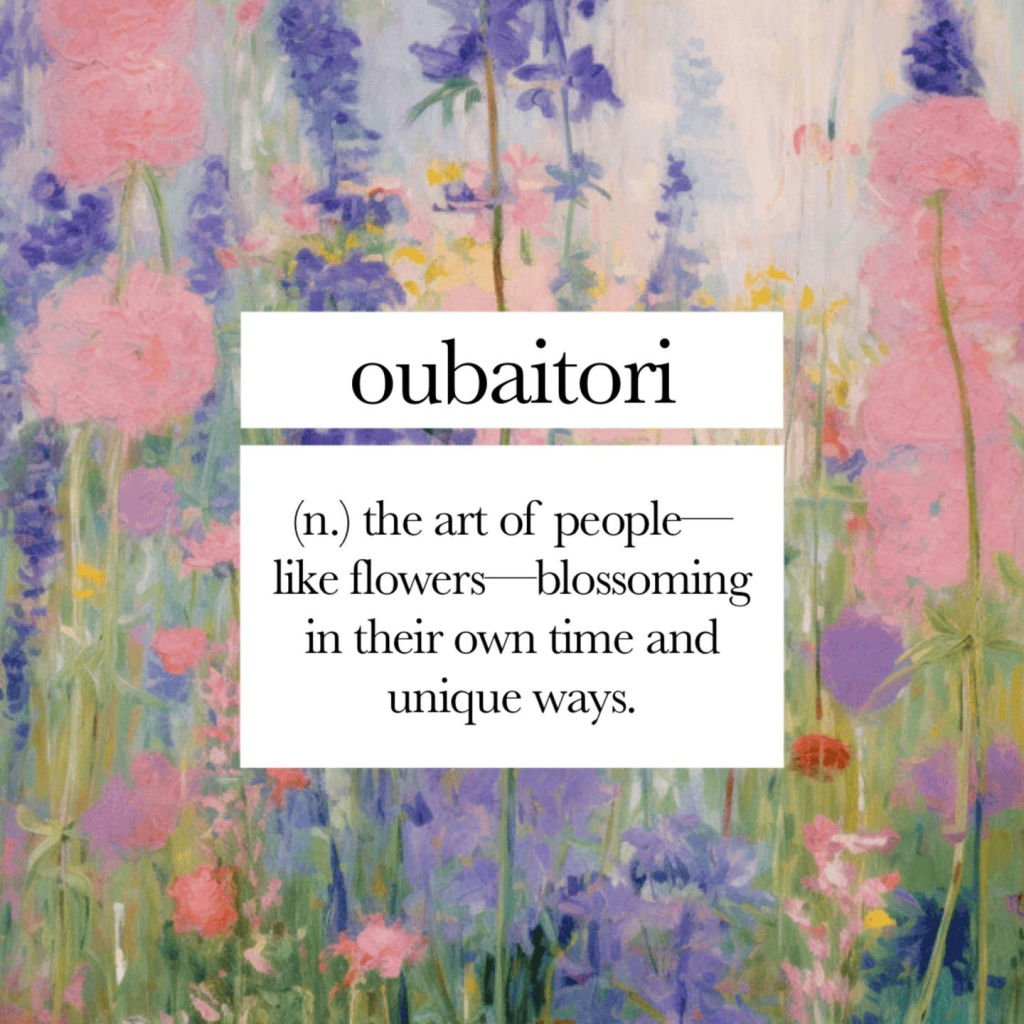
Oubatori
The Beauty of Your Own Bloom
By Samantha Shrock
Nature cycles through vivid and hidden rhythms of growth.
One elegant example is found in the concept of oubaitori. This Japanese word refers to the four distinct fruit trees that blossom during the country’s spring season: “cherry, plum, peach, and apricot.”
These trees share a season of renewal, yet bloom in intervals. Plum flowers appear first, followed by apricot, then peach, and finally cherry. These staggered windows of formation highlight intricacy and originality, enhancing the detailed beauty of each unique tree.
How true is this of people?
Being an “early” or “late” bloomer doesn’t expand or confine you. Your speed of growth doesn’t define your capacity to create a beautiful life. One method is not superior to another—we each bloom in our own time. Oubaitori cautions against comparison, advising instead to celebrate the beauty of each unique formation. Growth is not a race; it is a rhythm.
Seasonal awareness is mindfully embedded in Japanese culture. The recognition of fleeting beauty—sometimes referred to as mono no aware, the gentle awareness of impermanence—encouraging attentiveness to timing, change, and transience. Oubaitori reflects this same sensibility. It suggests that difference in timing is not deficiency—it is design.
This stands in sharp contrast to the optics and metrics that shape modern life.
From early education to adulthood, we are trained in the art of comparison. Who learned first, who advanced faster, who achieved more, who arrived sooner. In professional spaces, comparison can become even more pronounced—promotions, prestige, output, influence. In personal life, milestones are measured against peer-averaged pacing.
Yet human development—psychologically, emotionally, professionally—is beautifully nonlinear.
Developmental psychology reveals that growth occurs in uneven stages. Experiential skills of tenacity, resilience, and emotional maturity emerge at rates relative to environment, temperament, and opportunity. Outward “delay” may disguise depth in process, while rapid ascension without groundwork eventually exposes an unstable foundation.
Comparison distorts the beauty of becoming. Neurologically, comparison activates threat responses in the brain. This triggers stress and insecurity, minimizing perspective. We unintentionally shift from growth to self-scrutiny—Am I ahead or behind?
Oubaitori invites a different frame:
Am I developing?
Still, there is a distinction between stewardship and stagnation. Growth is cultivated through diligence and consistency. A tree doesn’t bloom without steady nourishment—but a tree doesn’t bloom faster because its neighbor is further along. In oubaitori, these fruit trees don’t compete; they simply fulfill their nature.
Mastery takes time. Some rise quickly into leadership roles and learn in the fire; others accumulate quiet experience before stepping forward. Both trajectories produce capable, thoughtful leaders. Speed is not the sole indicator of readiness.
Your timing is your own. Your growth is your own.
This truth invites patience, self-compassion, and reflection. It encourages us to recognize that our unique trajectory will yield fruit in its own season. When it does, it will be beautiful, just as each tree in the orchard blooms in its appointed time.
Consider your own “season of bloom.” Are you rushing your growth, comparing yourself to others, or overlooking the steady development you’ve already made?
The cherry tree does not outshine the plum. It blooms at the right time—and so will you.
Bible Study Curriculum: Who is God?
Written and Administered by Samantha Shrock
Target Audience: Adult believers (18+)
Setting: Small group or classroom
Duration: 60-75 minutes
Materials: Bibles, paper, pens, whiteboard
Lesson Overview
The intent of the lesson is that the audience should gain and apply understanding of God’s multifaceted character. Many learn of God’s unconditional love, mercy, power, and grace, yet project human fallacy and fallibility onto the character of God. These misconceptions about the Father can quietly undermine the framework of faith when left unaddressed.
The key thematic focus of this lesson is that actionable faith is not intended to check boxes. Actionable faith is gradual sanctification. Believers are biblically called to express their love for the Lord by obeying His commands in a posture of trust–especially when outcome is unknown. Biblical sanctification reflects the character of Jesus without hinging on earthly qualifiers such as performance or external validation. Foundational understanding of Christ’s true character is imperative, as a Christian’s fruit naturally begins to reflect Christ’s character in a surrendered, daily pursuit of truth. Even so, saints on earth remain sinful by the nature of their flesh. Expecting perfection is fruitless, but finding peace in His promise to redeem those who are sealed by His blood is fruitful. Jesus has already paid the price, atoning for sin and claiming victory over death for the saints to stand blameless before the Father’s throne. We remain imperfect, but we are washed clean and renewed day by day. The surrender that invites that renewal is actionable faith, because we are choosing to trust in the biblical character of God.
Practical Learning Objectives
By the end of the lesson, participants should be equipped to identify at least five scriptural attributes of God, contrast cultural misconceptions of God with scriptural truth, and articulate how accurate theology shapes daily obedience.
Educational Activity
Opening Prayer:
“Father, we meet you here with humble hearts. I pray that Your presence would fill this place, for where two or more are gathered in your name, you are near. I pray that you will speak through me during this time, Lord. Use me as a vessel to communicate your will–and may your will be done. Fix our eyes and our hearts on you, Jesus. Train us to be receptive to your Word. Train your sheep to know your voice. Thank you for meeting us where we are. It’s in your mighty and matchless name we pray, amen.”
Introductory Question: What is a common lie people believe about God?
Creative Element: Take a few minutes to connect with those around you. Share a characteristic you know to be true about God. Then, come together as a group and compile a list of the truths you spoke to one another about who God is.
Book: Let’s measure the consistency of these traits with what scripture says about God’s identity.
James 1:17: “Every good and perfect gift is from above, coming down from the Father of the heavens, who does not change like shifting shadows.”
Observation: 2 Major Characteristics: Perfect, Constant
Interpretation: Sin and resultant suffering are not God’s doing. His perfection means he is without fault; therefore, he cannot commit sin. No part of his nature is corrupted by evil. If any characteristics on the list harbor sinful motive or action, we will eliminate them, because they are incongruent with Scripture.
Interpretation: The biblical law by which God desires his children to live is unchanging. His consistency means He will not change His mind about the conditions of His commandments over time. God’s declared truth is the singular, unwavering Truth. Let’s add this to the list and eliminate any traits that coincide with fluctuation or flippancy, because they cannot be true.
Integration: Anxiety and stress are often reactions to unpredictability. When outcome is uncertain, we brace ourselves by mentally preparing for potential scenarios. Even so, earthly outcomes shift, disappoint, and defy expectations. When misplaced trust leans toward our own predictions, how do we redirect that trust to the Lord? How do we find rest in God’s perfect, unchanging love?
Application: Write down one current uncertainty in your life. Beneath it, write: “God’s character is constant even when outcomes are not.” Pray over that statement daily this week, asking the Lord to align your emotions with His unchanging nature.
Matthew 6:26: “Look at the birds in the air, they do not sow or reap or store away in barns, and yet your heavenly Father feeds them. Are you not much more valuable than they?”
Observation: 2 Major Characteristics: Provisional, Sustaining
Interpretation: God is for his children. He desires that his children be satiated and fulfilled. The only permanent form of fulfillment is derived from His love. When we entrust him with our lives, he cares for us and sustains us. Our lives are not our own to manage, and our provisions are not our own to meet. The Lord alone is our provider–he equips us with the strength and stamina to succeed, fulfilling his role as our sustainer. Let’s add these to list and eliminate any traits that embody negligence, because they cannot be true.
Integration: Earthly security–careers, relationships, finances, health–is not guaranteed. How does God’s provision remain centered as our foundation when these earthly fixtures are shaken? What does trusting in God as our provider look like in the face of job loss? Unwanted divorce? Chronic illness? The death of a family member? The end of a friendship?
Application: Identify one area where you feel financially, relationally, or emotionally insecure. This week, surrender that area in prayer each morning before making daily decisions. Practice seeking God’s wisdom before seeking control.
Numbers 23:19: “God is not a human being, that he should lie, not a human being, that he should change his mind. Does he speak and not act? Does he promise and not fulfill?”
Observation: 2 Main Characteristics: Honest, Faithful
Interpretation: When God speaks, God delivers. Though the format or timeline of the story may unfold differently than expected, He is always faithful to fulfill his word.
Interpretation: You’ll start to notice that these different passages overlap and describe many of the same traits of God. This verse in Numbers also addresses God’s consistency, as we saw in James 1:17. Also, we note his faithfulness in sustaining us as demonstrated through Matthew 6:26.
Integration: When persistent prayer doesn’t yield desired results, the enemy often tempts us to doubt the Lord’s trustworthiness. Where have we mistaken our perception of “delay” for God’s denial or abandonment? How would our behavior change if we truly believed that God cannot lie or fail?
Application: Choose one promise of the Lord that still feels distant. Read it aloud for seven days, asking the Lord to strengthen your trust in his timing over your own expectations.
Closing Prompt: As these elements of God’s character come together, how do they compare to the ideas we expressed before we revised the list?
Interpretation: God’s discipline is not rooted in condemnation, but in loving correction. His candor validates his convictions and prophecies, which have been repeatedly fulfilled. His love is reflected in his desire to train us in the way we should go, and he is faithful keep his promises.
Final Application & Theological Thesis: False notions of God taint our understanding of His character. The only infallible, inerrant, and communicable testament to God’s character is his Word–where he explicitly tells us who he is. The Bible defines and exemplifies God as perfect, constant, provisional, sustaining, honest, and faithful. Sin does not corrupt God’s nature, so God’s identity cannot inhabit sin.
To experience the fullness of a relationship with God, we reject and combat the enemy’s contortions of God’s character. We commit to actionable faith in God’s promises by allowing him to sanctify us. The enemy seeks to corrupt what is holy, righteous, and pure. Manipulation characterizes the father of lies. Jesus promises abundant life to those who follow him, and his biblical character is consistent with that commission. As believers, we remain sober-minded and vigilant, guarding against the lion who seeks to devour. We stand firm in faith, supported by the Rock. We practice discernment, attuning to Father’s voice. These actions demonstrate our love for him, signifying our trust in his infallible character.
 Samantha Shrock